Safari Means Journey

Safari is a Swahili word meaning Journey. This is our journey as a missionary family living and working in Tanzania, Africa.

Helping Others

Taking baby clothes to a baby wrapped in a single piece of cloth.

Learning the Culture

We are always learning more about the language, culture and customs.

Preaching and Teaching

The Bible is taught through preaching, teaching, tracts, and home Bible studies.

Making a Difference

When you are teaching the Bible you are making a difference for eternity.

Showing posts with label Food. Show all posts

Thursday, March 1, 2012

Roadside Roasted Corn


The Corn Crops in Tanzania are one of the most common sights that you will see during the growing season. Everyone, Everywhere, is growing corn. The most popular way that corn is eaten is through Ugali. The dry corn seed is ground into a corn meal, and then cooked into a hard dough and eaten in the form of Ugali.

Another popular way to eat the corn is is by roasting the corn on the cob. Here are some pictures of a man roasting corn on the roadside. Even after many years of living in Tanzania, I was hesitant to eat corn in this way. I wasn't afraid of the taste but of getting sick. You see this corn is usually always cooked on the side of the road so that the people walking by will have easy access in buying it. If you stand along side a road in Tanzania, you will probably soon be covered with dust, and vehicle exhaust fumes. During the dry season you can see the dust fly up in the air and then land on everything... including the corn roasting along the roadside. Regardless of this fact, I have been curious of what this corn taste like. One day a friend gave us some of the roasted corn. Out of politeness, I put the vision of dust and smoke out of my head and took a bite. To my surprise it was really bad at all. It didn't have a dirt or smoke taste at all. I was pretty bland, hard and crunchy. It tasted nothing like the soft, sweet, taste of corn on cob in America. The kids quickly wanted some, and They Loved It. It is funny what you get use to after living here for a while. Not long after this experience I found myself driving by a roadside corn stand and I was wanting to stop and get some. I thought to myself, "It is hard, bland, and probably dirty, Why are wanting to eat that?" And then I actually answered myself. (Yes, I know, kind of scary that I not only talk to myself, but answer myself) Anyways, I thought,"Well, because it is good, and I like it." Soooo the kids and I pulled the car over and I bought everyone some roadside roasted corn...And it was Good regardless of what I told myself.


Thursday, December 1, 2011

Homemade Hot Sauce


My Husband Is Awesome !!!

One of the things that we miss about America is the Mexican Food. We Love hot sauce, and chips. Well this week my hubby made some homemade hot sauce, and Canned it. It was even nice enough to make some mild, and some hot. He likes it Hot ! The Gee Family in Arusha previously gave us the canning supplies and we finally put it to use. The canning part is nice because it preserves the sauce for a long shelf life. We also had homemade tortilla chips with it. Yumm!!!


I couldn't help but think about the people in the nearby villages, and how helpful the canning process would be for them. Their selection of fresh fruits or vegetables is very limited. For those living in town, there is the central market, with a wide variety of foods. The problem with canning is that Tanzania doesn't have the jars and lids for this type of work. To actually can, all it takes is a fire, pot taller than the jars, and water. The trick is having the water boiling a few inches above the jars.

We have killed our own chickens, butchered pigs, kept a garden, and now canning, sometimes I really do feel like Little House on the Prairie.

Saturday, November 26, 2011

French Toast


As part of Aubrie's home school she has been working on Home Economics.
AKA - Help mom around the house.

Here she is with her fake smile for the picture. :-) 

On this morning she was helping me to make french toast.
I have also been teaching her to peel carrots, use a microwave, and toaster.

She is such a good little mommy's helper. 

Here is the French Toast Recipe 
(I sometimes add a drop of vanilla or nutmeg to the mixture.)

Hint: 
If the bread seems a little soggy after cooking it then you 
can toast it first before putting it into the egg/milk mixture.

I also put the oven on low heat and put the cooked 
french toast on a cookie sheet in the oven to keep them warm.

Saturday, August 20, 2011

If You Were Born A Maasai Woman


Have you ever considered what your life would be like if you were born into a different culture. If you were born a Maasai woman then your life would be different in so many ways. I often pray for the Maasai women and children here in Tanzania.

Your life may be similar to this...

You wake up and wrap yourself in a cloth that you have laid out to wear today. You only have one pair of sandal shoes, so you slip those on your feet. You them begin to sweep your one one dirt floor home and wait until tomorrow to fix the grass roof. You also notice that tomorrow you might need to gather some more cow dung and mud for the walls and floor. You will mix it up into a smooth mixture and apply it with a flat stick.

For now you decide to go ahead and make the long journey to collect water. Your only water source is miles away, and it is from a dirty, diseased water pond. It is also the same source of water for the cows to drink. You collect your water with large buckets, put one on your head, one in your hand, and head back home.

After you make it back with the water you go to look for some firewood for your cooking. You find your dull cutting tool, and head out. You climb up to cut branches from trees and bend over to pick up large branches that have fallen. During the wood gathering you are watching out for snakes because you know that one bite is often deadly. Once you have gathered enough wood for cooking, you tie the branches together with some bark that you have pulled off from a nearby tree. You put the bundled wood on your head, and again make the long trip back home.

You then start to cook some food. You don’t have to worry about what to cook, because there is only one thing to eat, your corn meal mush, called ugali. You are glad that the corn crops were good this last rainy season because you still have lots of corn meal which you have made from pounding the dried out corn.

The cooking is done in your little one room hut because the wind outside would blow out the fire. You sit in your smoke filled house, coughing and wiping your burning eyes. You have a little trouble seeing where you put your stirring spoon because the house is dark and has only one small window. 

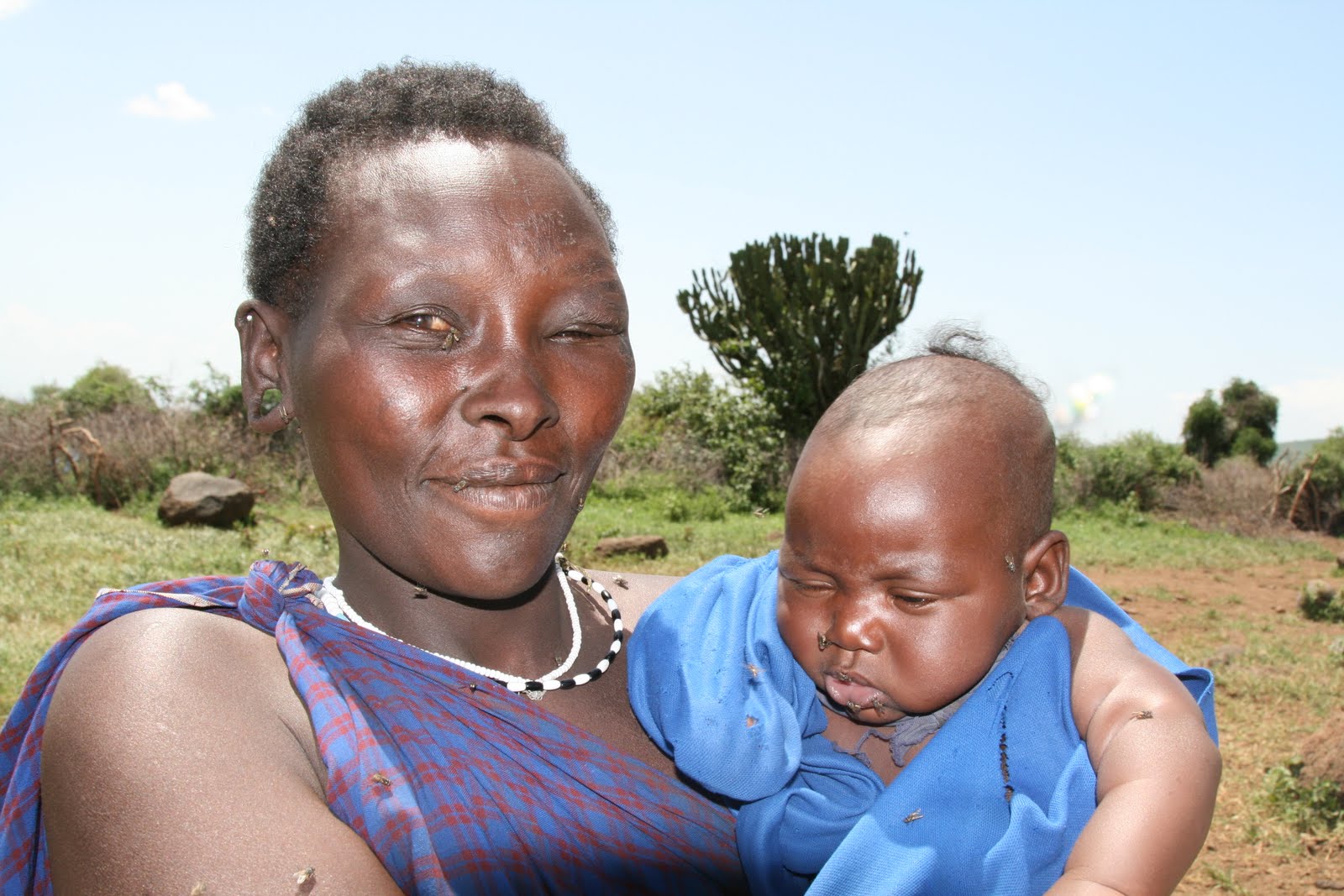
Did I mention that during all of this, you have a baby tied to your back. You can feel that he is wet and you need to change his cloth. He is not wearing a diaper or any clothes, he is only wrapped in a blue cloth.  You know that you will keep giving birth, no matter your age or health, because many cows and many children are seen as a status symbol for your husband. You have given birth eight times before, but many of your children are not alive today. You are grateful that this one is healthy. You know that the tribe doesn’t even recognize babies until they are three months old, because there are so many infant deaths.

You are just one of your husbands many wives. You have recently overheard that he may be getting another wife, one that is 15 years old. She has recently had a female circumcision, like you did when you were her age. He is excited because her dowry is only 3 cows and a goat. You know that it is traditional for the Maasai husbands to openly beat and abuse their wives. You are thankful that yours hasn’t done that in a long time.

After you have served everyone their food, it is time for laundry and dishes. You bend over to scrub the clothes and wash the dishes with what little water you have. You don’t have any soap so you just do the best job that you can. You try to reserve some of the water left over for drinking, cooking and bathing.

Your children, ages 3 and 5 were in charge of herding the cows all day and they have just returned.
It is now time to go and milk the cows. When you are done milking you set it aside to ferment for a few days. You see your children covered in dirt and dust everyday. You know that it would take to much water to give them all a good bath, so you at least try to wash their hands and face.

You look around you and see all the flies. It is so dry right now that the flies keep getting into your babies eyes and mouth to drink. You have tired to fight them off at first, but now that idea just seems impossible. You are ready for the rainy season but fear the mosquitoes and the malaria that kill so many during that time of year.

Since you are a woman, you have never been to school. This is the only life you have ever known. You go to bed on a dirt floor happy and content. You are happy because your families health is good and no one is going to bed hungry. You are content because you have served your family well and have done the best job that you can do. 
....................................................................................................................................

I often think about how much more we, as Americas are given. Our lives are so much more blessed, yet are we happy and content. All to often we listen to the television, radio, magazines, etc. that tell us we need more to be happy and content. The Bible teaches us that we should be happy with just food and clothing. How often do we just want more.. more things, more spare time? We need to search the scriptures, find happiness and contentment in Him, and say a prayer of thanksgiving for the life and blessings that we have each day.

About the pictures:

The above picture is of a Maasai woman and her youngest child, named Omari. She had given birth to a total of 9 children, but many had previously died. You can see her one room mud hut in the background of the picture above. If you look closely at the picture below you can see that her face/eye is swollen, as she had recently been beaten.


We visited this woman again at a later time, helping her with a mosquito net and childrens clothing. I often think of her and her life.

Friday, February 25, 2011

Bringing Home The Bacon


After being here a few weeks we slowly began to learn where you can by food and local supplies. One of the first things that we looked for was a store that sold good, clean meat. Tanzanians don’t eat meat very often, some only eat it on a holiday or special occasions. They mostly just receive their protein from beans, and an occasional egg or cows milk. The beef or pork is usually hanging up outside all day in the heat, in an open “duka” store, and usually covered with flies. The chicken is usually running around until it is caught and killed. We did find a store in town that has a refrigerator and freezer for storing meat, and it seems to be clean and of good quality. The down side is it is more expensive. So if you are willing to eat the meat with flies, you can choose that or go with the more expensive option. This is one reason why it can cost more in Tanzania when you don’t want to expose yourself or your family to some of the typical food-borne illnesses.
I saw all this to tell you the idea that Carey came up with to save some money. He could hear, and smell, that many of our neighbors were raising pigs. His idea was to “bring home the bacon.” So off he went to the neighbor house to see if they had a pig to sell. The above picture was of “Muddy”, named by the kids. One day Carey is seen coming down our road, dragging a pig behind him. I couldn’t help but think of the rhyme: To market, to market, to buy a fat pig, home again, home again jiggety-jig. It was a hot day and the pig seemed as if it was about to overheat, so water was quickly poured on her to revive her. She quickly began to root around in the newly fresh mud, hence the name that the kids gave her, Muddy.

The next morning Carey got up early and went out to do the dirty work of turning Muddy into meat. A friend and fellow worker here, named Charles, helped to prepare the pig. It is traditional Tanzanian custom to shave the pig, after it has been killed. The purpose is so that you can leave the skin on it when it is cooked. So that is what is being done here. The pig got a good shave.  Hot water is poured on the skin and it is shaved with a sharp knife. Because of the hot water the hair easily comes off.


Soon after that our garage became a slaughter house. Now I know a lot of women who might be completely disgusted by this. But really I didn't mind. I was glad because I knew that the meat was being handled correctly, and I knew that it was going to be clean and fresh.


Now I know others that may look at the above picture of the ribs and be grossed out, but I bet they are not grossed out by the Chili’s baby back ribs commercial. (Smiles)
We have a large deep freezer that comes in handy for occasions like this. Carey cut up the meat, labeled it, and put it in the freezer.


By late lunch time we had meat! I sauteed up some pork cubes and I made a Tanzanian dish called Pilau. It is made up of mostly rice, with some meat, carrots, potatoes, and onions. It was delicious !


One thing that I love about being here in Tanzania, is that nothing is wasted. Tanzanians eat Everything from the organs, to boiling the bones, to cooking down the pig fat to make cooking oil. With the meat scraps, and extra parts of the pig, we were able to help other families with food. I sometimes feel guilty giving someone the “scraps” but to them it is a nice gift. They were so thankful and so appreciative. Here is a picture of pig kidney, cooked and served up on a leaf. 


In the end we ended up with a lot of meat in the freezer, saved a lot of money, and were able to help out a few people in the process. 
Until Next Time,
Bonnie

Share

Twitter Delicious Facebook Digg Stumbleupon Favorites More